June 18, 2016

The Hardest Thing I Do

This story happened quite a while ago, but I is similar to situations that happen way too frequently. I responded to an unresponsive party on a train. Dispatch reported that the party may be a cardiac arrest. The train, which was full of other passengers, was stopped in the station waiting for us to deal with the issue. I boarded the train to find a 20-something male snoring and smelling strongly of alcohol. (He was not a cardiac arrest.) His skin signs were fine, there was no apparent trauma, and both his respiratory status and pulse were normal. I made the choice to wake him up and get him off the train; that way the dozens of other inconvenienced people could go on about their lives.

It took more work than I expected to wake this gentleman up.  Neither voice nor shoulder shake worked. I had to press the base of the SCM* to even get a grimace and a withdrawal. The man groaned and twisted toward his side, like a tired hotel guest who wanted to sleep in.  “Come on, dude. Up and at ‘em. We got to get off the train,” I said as I gave him a little more SCM pressure. That was enough for the man to get his feet under him and walk off the train.

I sat him on a bench to complete my exam and work up. The pain at his clavicle, along with moving a little bit, woke the man up a little more. Now he wanted to be aggressive and belligerent. He stood, though I asked that he not, balled his fists, and explained that he was going to kick my ass. The man began to shuffle toward me in an ataxic fighter’s stance.

This is not a person that puts me in an excessive amount of danger, in most cases. There is always a chance of getting hurt, I suppose, but my main concern at this point was the hassle his behavior was causing. I began to slowly back off, circle, try to talk him down, and get him into a position so I could finish my job.

He hocked up a big ball of mucus, spit it at me, and threw a giant, arcing haymaker that missed.

Do you know the call I’m talking about? Ever run a similar one? How about another example?

My partner and I responded to a downtown club during out-crowd on a weekend recently. We found a different 20-something male who was intoxicated and had received an ass kicking. I’m sure it wasn’t deserved, though. He had a laceration extending the length of his left eyebrow, smelled strongly of alcohol, and was shouting profane threats at the bouncers, police, my partner, and me.

I have a theory that men like this feel a subconscious need to regain face. This is especially true if they lost a fight in front of a girl. I think there is enough lizard brain peeking through the alcoholic haze to make a decision: Against whom should I regain face? The bouncer? Nope, already lost that battle once. The cops? Nope, not unless there is a female officer. Police are mean. The medics? Unarmed, here to help, softer than the cops. Yep, he’s going to decide to regain face against the medics.

I never understand why people direct their anger at me. I didn’t beat them up. I didn’t arrest them. In the end, it is just that I’m just the safest target for their impotent rage. They never run away, either. Just stand there and shout how they aren’t going to any damn hospital.

This genius was unhappy at my decision to take him to the hospital and decided that he had a right to my name, right at that moment. My identification badge was clipped to my chest pocket. He snatched it off my shirt and gave me a shove.

Have you run that guy?

As a final example, check out this video from YouTube.** It makes my guts tighten up. I have been there and I hate it.

Powerful waves of frustration and anger roll over me. None of this is my fault! Everything about this situation is due to someone else’s decisions! I shouldn't be treated this way!

In most settings, spitting on another full-grown man isn’t a safe action. There are unpleasant consequences. Snatching a man’s possessions and shoving him is not safe. Consequences. My uniform is what renders those actions safe. That, and my decision to walk away when I feel the tide of frustration and anger welling up. 

Contrary to the approach of a lot of EMS safety training, I walk away to protect the other guy’s safety, not mine. I have an unbroken seventeen-year streak of not engaging in my baser instincts that I’m trying to protect. I walk away, take deep breaths, imagine that my daughter was watching me, work at the gym until I want to puke, drink too much, bitch to my peers, complain to my wife, bike, jog, and all of the other better options than administering 80 kilograms of brutacaine to a patient deserving of a dose. They are better options (mostly), but not especially satisfying ones.

Sometimes the hardest thing I do at work is not do what I want to do.


*Sternocleidomastoid (SCM) pressure is a good way to apply humane painful stimulus to a patient. It looks better than a sternal rub, doesn’t bruise, and so on. The SCM inserts at the medial end of the clavicle, on a tubercle. Right as it connects to the clavicle, it bifurcates. Press straight down (toward the patient’s toes) with one finger. Don’t press into the airway, or into a carotid pulse; just press downward onto the clavicle at the bony bulge where the SCM inserts.


**If my video embedding skills suck, click this link: https://www.youtube.com/watch?v=UOX3fXSoNJk

June 4, 2016

Recognize!

A few years ago, I took a lead fall while ice climbing. I was putting up the first line of the day near Frisco and cratered. I was too high above my highest screw, so it was actually a ground fall. But the ground didn’t hurt me. The icy knob about halfway down caught my right crampon, twisted my foot, flipped me so I landed on my back, and broke my ankle. It was so early in the day I didn’t want to mess up the trip for everyone else. I sat to the side, built up a spot to elevate my foot, and piled snow over my ankle. After a few hours, I hobbled my way out to my truck and drove myself to the emergency department. My pickup was an automatic – I could drive it with one good leg.

My big dilemma came when I arrived at the ED. What was the issue, you ask? Well, good question, gentle reader. Was the dilemma where to park near to the ED? Oh, no. Could it be that my quandary would be how to make my way from the parking lot to the ED with a broken ankle? Nope. One might guess that my issue would be how to use the “normal” entrance. That would be a good speculation, but a wrong one. Most medics don’t know where the “normal person ED entrance” is. They only know the ambulance entrance. And that wasn’t my problem.

My problem that day was that I didn’t have anything that noted me as being special. I didn’t have any paramedic markings.

A few years later, I had appendicitis. I was working in the paramedic office at the time and spent the morning at the doctors office trying to deal with the searing gas pain that had been bothering me for a week or two. He sent me to the CT, and afterwards I was getting lunch (stir fry) when my physician called and directed me to the ED. I had a hot appy and they would be waiting for me. I wasn’t worried about going to the ED that time. You know why? That’s right. I was in uniform.

I’ve heard stories from medics about putting on paramedic t-shirts in the middle of the night before taking their kids to the hospital. I’ve heard of medics leaving a shirt with the patches visible in case they get pulled over. I have a Division sticker on the back window of my car. Sometimes we try to hide our affiliation, but we definitely want to be marked as being on Team Emergency Worker when it suits us. The two primary times it suits us to be identified as paramedics is when we present to a hospital and when we are pulled over by the cops.

I wasn’t looking for anything special when I broke my ankle. I didn’t expect to be carried through the department on a litter with trumpeters preceding me, or anything. (It would have been nice, but I wasn't really expecting it...) I was just looking to avoid the normal waiting room intake process. I didn’t want to sit there in a molded plastic seat with my once and future patients and broken ankle.


Good news! The charge nurse knew who I was! Apparently I am more recognizable than I realized. Notoriety is sometimes a good thing. (Infamous. I'm in-famous. That means more than famous, right?) A short couple of hours later, I was diagnosed with a medial malleolus fracture, splinted, and taken care of without problems. I even turned down opiates – my leg wasn’t especially painful and I had to drive myself home. Later, I ignored the orthopedist’s advice, so that ankle has bothered me since, but light duty was not pleasant. The best piece of the story is that on the evening when I went to the ED, I didn’t want to have to go through a busy waiting room. Success!

Colorado rules, by the way.

May 28, 2016

Unsympathetic

On occasion, paramedics and EMTs can be slightly unsympathetic to a patient’s plight. I can think of two prime examples, off the top of my head. Each occurs when someone contacts you for a complaint that you happen to be experiencing at the time, as well.

Eons ago, I came up with a phenomenally stupid idea to increase my stability in the back of an ambulance. (For background, a person is most stable when the person has at least a three-point base. This is true for rock climbers, as well as medics working in moving vehicles.) While working in a moving vehicle one day, I felt as though I could more easily nasally intubate an elderly CHF patient if I could use both hands. If both hands were working to secure the tube, however, one of them could not be my third point of stability. I decided to use my head as a third point of stability, by pressing it into the ceiling of the ambulance. Stupid, I know. Hindsight. I pressed my head against the roof and planted both feet. Three gobsmackingly stupid points of contact...

The system worked extremely well. I was stable as a statue until the speed bump.

After the speed bump, my neck hurt and I couldn’t feel my hands or arms. As a matter of fact, I couldn’t feel my arms for three or four days. I was so embarrassed I didn’t claim a work-comp injury. Hell, I was so ashamed I didn’t even tell my wife. I just kept dropping objects she handed me for a few days. I clammed up, kept it to myself and hoped to get better. I did. Mostly. Eventually. Apparently central cord syndrome can be a temporary injury. Who knew?

Since that time, I’ve had some neck and back problems. In all honesty, I had back and neck problems before that, because EMSing is hard on spines. Achy and spastic low backs are everyday complaints for many medics and EMTs. Sitting for long stretches, followed by heavy lifts with cold muscles and poor body positioning does not make for happy lumbar paraspinal tissue. Standing like some kind of asshole with your head pressed into the ceiling isn’t good for necks. Carrying combative fat ladies down steep-ass circular staircases while they holler and grab walls, bannisters, and door jambs is uncomfortable, and will be for several days afterwards, no matter how you do it and no matter how healthy your back is.

So imagine having intermittent back spasms on a cold, dark night. Imagine, further, that you can’t take “good medications” because you are at work. So, hypothetically, you are taking enough ibuprofen to make your ears ring so you can finish your shift. Visualize the fact that you still gasp and whimper every time you move your lower body. Imagine at that point you run a full-grown man complaining of intermittent low back pain for a year. Tonight is the night he wants to get it taken care of. He doesn’t think he can comfortably walk himself downstairs and sit in a car to the ED.  He wants to be carried on the bed. He won’t listen when the medics tell him that the ED will merely refer him to his PCP after wasting a few hours of his life.

What do you get on that call? That’s right. Unsympathetic medics.

Here’s another example. December 31, 2010, saw a high temperature of 9°F during the middle of the day. After the sun went down and things cooled off, me and seven other medics got on bicycles to ride around downtown for ten or twelve hours and cover EMS calls. At the time, I was a Captain and partnered up with another Captain. Between us, we had thirty or forty years of EMS experience in the system.

Let me pause a minute and explain how cold it was that night. The weather service reports a low of 0°F with 22mph winds and 40mph gusts. That works out to wind chills of -23°F to -29°F. Below. Zero.

We were on bicycles, running the downtown revelers when they fell down or passed out. Twenty-three to twenty-nine below wind chills. On bicycles.
I'm second from the left, with my head down, adjusting the ice climbing gloves I was wearing.
Ice climbing gloves. The ninja to the viewer's right from me is froze solid.
(Author's collection)
At about 3am, as things were winding down, we were parked in front of a decent hotel clearing up a call. A lady walked up to me and the other Captain. She was cold and wanted our help. See, what had happened was that she got mad at her boyfriend and he went home without her. She was wearing a cocktail dress with toeless high heels. She was cold and uncomfortable.

What do you get in that situation? That’s right. Unsympathetic medics.

I could go on and on. What calls do you find yourself to be most unsympathetic? Let us know in the comments.

May 21, 2016

My Threshold is Coming Down

I remember a call from a couple of years ago where I blasted a 12-year-old female with Haldol. At the time, it felt wrong. In hindsight, I should have given it sooner.

My partner and I went to a junior high school for an “Unknown Medical.” I arrived to find the school security guard with a story: A student walked past one of the security guards smelling of weed, so the guard stopped her and attempted to search the kid’s backpack. The student was resistant to that plan, so she was taken down. But she was, you know, taken down all gentle-like. So they didn’t think she was hurt. But they would like me to “just check her out.”*

The sixth grader was covered in the smell of marijuana like Pigpen is covered in dirt in the Peanuts comics. She was making my eyes water and my mouth dry out, just being near her. Her secondary exam and vitals were fine. The school had attempted to contact her parent or guardian listed in her records, but there was no answer. The funny part of the call was when the security guards were surprised that I was going to transport the student.

"Wait. What? You need to transport her? She isn't hurt!" (Then why did you call me?!?)

Just check her out, my ass. A minor, without parental contact, in a still-ongoing cloud of marijuana, and with a report of trauma (however minor) is going to the hospital. I don’t know what they expected to happen. Anyway, we went to the ambulance and that’s where the brawl started.

See, the kid agreed with the school security guard, at least in this case. She did not want to go to the hospital. Just getting her in the side door of the ambulance was like getting a cat into a bath. All four limbs locked with hands and feet on the door. We’d break down one limb, only to find another locked out. Eventually we got her onto the bed, put the seatbelts in place, and restrained her wrists with Velcro restraints on the pram.

One EMS secret I have learned in my time on the street is that there is no patient more impossible to restrain than an enraged 13-year-old female. The only way to make it worse is to find an enraged, drunk, 13-year-old female. Twelve is close enough. No f**ks are given, no joints are undoubled, no pain is felt, no logic can reach them, and no restraint shall hold them. I have a theory – the problem is that medics don’t want to hurt 13-year-old girls. If it were a drunk 22-year-old male, dude would be restrained. Thirteen year olds present a problem. And they are angry, flexible, and surprisingly strong. Restraints pose no problem.
Maybe I could transport them safely in this 19th Century mess...
Source
Eventually, I had to administer some IM haloperidol.

What kind of jerk gives chemical restraint to a thirteen-year-old girl? Me, that’s who. In hindsight, I spent too much time and energy negotiating, begging, and cajoling the patient into holding still and submitting herself to transport.

I could have maintained her to the hospital on the pram with physical work and physical restraints. I know how to cowboy up and get someone to the hospital. But fighting and escaping in a moving vehicle is dangerous. Dangerous and exhausting.

I need to lower my threshold for chemical sedation of angry/violent/confused patients. I am a reasonable person. If your behavior is such that it is pissing me off, your behavior is outlandish. You should be sedated. In addition, it is dangerous to fight and escape in a moving vehicle. Flight nurses and medics friggin' paralyze people to avoid combativeness in their moving vehicle. And here I am, counting on Velcro or kerlix restraints, negotiation, and physical holds.

It is dumb. It is too much work. It leads to people being inadvertently hurt. It leads to people escaping. It leads to medics and EMTs being hurt. It leads to a loss of dignity for people who need our help. 

So I am lowering my threshold for administering chemical restraint.

I’m not saying that everyone needs Ketamine. Appropriate force escalation and medication choices are still important. Physical restraints and negotiation are fine in some cases. I find that Haldol works fine on psychiatric- and alcohol-related combativeness. Versed works fine on sympathomimetic combativeness. Ketamine is fine for excited delirium.

But I think I should use each of them more often.

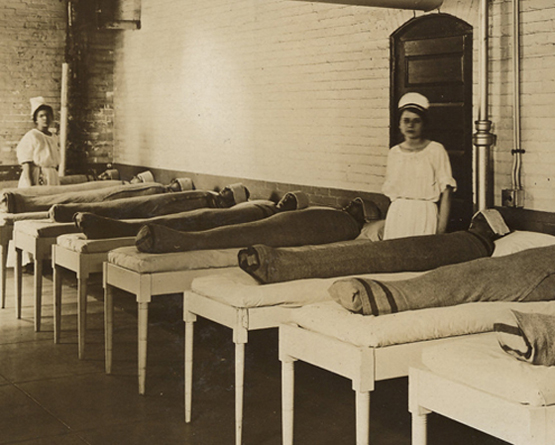
As an aside, this is a psychiatric hospital with patients restrained with wet blankets. Wet. Blankets.
Source


*Future blog post rant about “just check her out” to be published soon…

May 7, 2016

The Most Paramedic Offer of Help Ever

A paramedic friend of mine was traveling through the American southwest this week, a long road trip across a straight ribbon of asphalt. I picture reddish rock mesas, creosote, and sagebrush. As he crested a hill, he found a police cruiser blocking the road. The highway ahead was closed.
It probably wasn't so picturesque a location as this.
Image by Moritz Zimmermann (Own work) [GFDL or CC-BY-SA-3.0], via Wikimedia Commons
My buddy got out of the car to chat with the cop and discovered the highway was closed because of an accident ahead. The medic mentioned that he was a high-powered, experienced medic in a big city EMS system. Did the officer think that he should go ahead to offer whatever help he could provide? The policeman didn’t have to think about it at all. He said something vaguely disparaging about the state of the volunteer firefighters in the area and sent my friend through the roadblock. He told my friend that the crash was about a mile up the road.

So my friend was through the roadblock. But now he had a new problem, about a mile ahead.

He took a deep breath and rolled up to the accident slowly, evaluating the scene as he coasted through. He tells me that he was looking for a convenient place to park his truck, but I’m not sure I believe him. The accident didn’t actually look especially severe. Mild to moderate mechanism. Everyone involved in the grinder was upright and walking around while wearing c-collars.

Meh. Things looked fine. Flatten hand, fingers together, attach thumb to temple.

Yep. My buddy kept going through the accident and onward to his destination.

Only a medic would play the hero card to get through a roadblock, but then cruise past as though he was on a normal commute to work.